Thursday, July 9, 2020

Wednesday, August 15, 2018
Ups and downs season winding down
This summer has gone by so fast! Overall it's been a great season for the Monarch. By all accounts they are going strong this summer in the midwest and north, hopefully that means there will be an abundant number headed to Mexico, and more to return next spring...time will tell.
I have had so many firsts this year, it's been a season of learning and trial and error.
First of all I will have raised well over 200 monarchs this season, that's about 3-4 times more than ever before. Because of the numbers there have been many other firsts as well.
The NP virus that I believe wiped out 2 dozen or more back early in July. That was a huge learning experience and forced me to change the way I was "housing" my brood. Because I am trying to put fewer cats together, and keep my enclosures cleaner, I have been constantly doing what I have dubbed the caterpillar shuffle, which consists of changing leaves, moving caterpillars from one enclosure to the other based on size and number of cats per enclosure and CLEANING FRASS (caterpillar poop!)
I have also been much more careful about allowing butterflies to eclose (hatch) in enclosures with feeding caterpillars, because that can also cause disease to spread. So not only am I doing the caterpillar shuffle, but the chrysalis shuffle as well, moving chrysalis, or removing tops of cages and replacing them with other tops...which are not always secure so I have butterflies eclosing in my porch that I didn't know were there.
I've also had a chrysalis turn clear, so the butterfly is visible and NOT eclose. So far haven't had anyone else tell me that's ever happened to them. It looks completely normal, but it's been like that for 5 days now....I don't believe it will eclose at this point.
I also had a very small caterpillar that was not eating, or pooping normally, so I removed it from the others and put into a small container, because I believed it might be sick. It never did eat, or grow, but one morning I found it hanging in a J and it made a tiny little Chrysalis. I will test it for OE parasite when/if it ecloses....which brings me to another first. I did bleach some of my eggs, and tested butterflies for OE, which consisted of looking at their scales under the microscope. All of the butterflies I tested were negative, so that was very encouraging, and it was a fascinating experiment. I will begin tagging butterflies sometime next week. I currently have about 30 plus in chrysalides, but have had 5-10 eclosing everyday, so I'm not sure how many of those 30 will get tagged. I still have at least 30 plus caterpillars that will form chrysalides in the next week that will all get tagged in Sept.
So it's been an exciting season to be sure. If you are raising Monarchs in captivity you know how much work it is, but it never gets old watching them wiggle into a chrysalis, or eclose into a butterfly, and when I beat myself up for the losses, I remind myself that in the wild those 200 plus caterpillars likely never would have made it to butterfly. After the season is over, and I've got some free time again (haha) I intend to write some letters to DNR, MNDOT and anyone I can think of and encourage our city offices and park services to allow milkweed to grow like it once did, and perhaps the Monarch will once again fly in abundance. So keep up the fight to #savethemonarch
I have had so many firsts this year, it's been a season of learning and trial and error.
First of all I will have raised well over 200 monarchs this season, that's about 3-4 times more than ever before. Because of the numbers there have been many other firsts as well.
The NP virus that I believe wiped out 2 dozen or more back early in July. That was a huge learning experience and forced me to change the way I was "housing" my brood. Because I am trying to put fewer cats together, and keep my enclosures cleaner, I have been constantly doing what I have dubbed the caterpillar shuffle, which consists of changing leaves, moving caterpillars from one enclosure to the other based on size and number of cats per enclosure and CLEANING FRASS (caterpillar poop!)
I have also been much more careful about allowing butterflies to eclose (hatch) in enclosures with feeding caterpillars, because that can also cause disease to spread. So not only am I doing the caterpillar shuffle, but the chrysalis shuffle as well, moving chrysalis, or removing tops of cages and replacing them with other tops...which are not always secure so I have butterflies eclosing in my porch that I didn't know were there.
I've also had a chrysalis turn clear, so the butterfly is visible and NOT eclose. So far haven't had anyone else tell me that's ever happened to them. It looks completely normal, but it's been like that for 5 days now....I don't believe it will eclose at this point.
I also had a very small caterpillar that was not eating, or pooping normally, so I removed it from the others and put into a small container, because I believed it might be sick. It never did eat, or grow, but one morning I found it hanging in a J and it made a tiny little Chrysalis. I will test it for OE parasite when/if it ecloses....which brings me to another first. I did bleach some of my eggs, and tested butterflies for OE, which consisted of looking at their scales under the microscope. All of the butterflies I tested were negative, so that was very encouraging, and it was a fascinating experiment. I will begin tagging butterflies sometime next week. I currently have about 30 plus in chrysalides, but have had 5-10 eclosing everyday, so I'm not sure how many of those 30 will get tagged. I still have at least 30 plus caterpillars that will form chrysalides in the next week that will all get tagged in Sept.
So it's been an exciting season to be sure. If you are raising Monarchs in captivity you know how much work it is, but it never gets old watching them wiggle into a chrysalis, or eclose into a butterfly, and when I beat myself up for the losses, I remind myself that in the wild those 200 plus caterpillars likely never would have made it to butterfly. After the season is over, and I've got some free time again (haha) I intend to write some letters to DNR, MNDOT and anyone I can think of and encourage our city offices and park services to allow milkweed to grow like it once did, and perhaps the Monarch will once again fly in abundance. So keep up the fight to #savethemonarch
Thursday, July 12, 2018
Triumph and Tragedy part II
This has been a very sad and exhausting week for me, and my butterfly project.
As of my writing earlier this week, I believed that the cause of my caterpillars sickness was pesticide poisoning, now I believe it was NPV, which is virus that is fairly common in caterpillars, and can wipe out any critter that comes in contact with it. I will not go into detail about it here, but I encourage you to look it up, and familiarize yourself with signs and symptoms if you are raising large numbers of caterpillars in captivity.
I ended up contacting the U of M Monarch lab, and here is what I learned....
Raising large numbers of caterpillars in captivity can be deadly if too many are too close together. It’s recommended that cats are kept in individual containers, or no more than 2-3 together, to minimize contamination if one becomes ill.
Any caterpillar that shows any signs of illness, green goo, poor appetite, unexplained behavior (IE writhing as though in pain) should immediately be removed and isolated if not already.
Anything that that caterpillar may have touched, enclosures, milkweed, other cats, even a handlers hands needs to be carefully sterilized before any further use.
Also remove any Chrysalides that are in the enclosure as the adult butterfly can carry the virus, and spread it wherever it lands....YIKES!
NPV and other viruses are fairly common in caterpillar populations, and anyone that is raising large numbers of caterpillars should expect to deal with it at some point.
So I learned a very sad, hard lesson. After having to freeze about 2 dozen caterpillars, including 3 that were in J’s and spending several hours disinfecting three enclosures with bleach, and giving away about a dozen caterpillars to a fellow butterfly lady I hope I am past this crisis. I am frustrated, and a little scared to start up operation again, but I will be much more careful in the future, and vigilant in my watch for any trouble.
So, will let you know what happens next! Stay tuned.
#save the monarch
Tuesday, July 10, 2018
Triumph and tragedy July 10
A lot has happened in my Monarch quest since my last post! I was out of town for 2 weekends over the holiday, and had to take my babies with me the first weekend, and leave them in the care of my capable daughter the second weekend. The first weekend was spent with family in Iowa, where I spent time caterpillar/egg hunting with grand nephews and grand niece. I came home with several additions to my menagerie. The next weekend was spent at a cabin near Bemidji Mn, where I was also able to SAVE the Monarchs one caterpillar at a time! I discovered a small clearing near our cabin that had recently been mowed, which sadly probably destroyed caterpillars and eggs, but there were many tiny plants beginning to grow back, and mama Monarch flitting from plant to plant laying her bounty. There were eggs and baby caterpillars on nearly every plant. Again I returned home to add to my ever growing caterpillar family!
Here's the tragedy part of the weekend; before we left I grabbed some milkweed from a spot I'd never picked before, and by Sunday afternoon I had 2 large cats that were vomiting up green goo (never a good thing) I've written in past blogs about viruses and infections from wasps etc..... I really wasn't sure what was happening, and I euthanized 4 big caterpillars. So I turned to my Facebook group for advice, a couple people said it sounded like pesticide poisoning. That hadn't occurred to me! SO LESSON LEARNED....don't pick unfamiliar milkweed, even if it is nearby and easy to get to, AND you're never so experienced that you don't need help from others sometimes! So, Monday AM bright and early I went to get fresh Milkweed, threw out all the stuff that was in my big enclosure, then moved the surviving cats to the fresh Milkweed and they almost immediately came back to life! I still lost 3 more that I think were just to sick to recover, time will tell if the others will recover, but they seem to be acting and eating normally again!
Another first for me....I had a caterpillar that was on the side of my glass aquarium, and it looked like it was planning to try to spin it's Chrysalis there, I knew that the Chrysalis would be deformed on one side, so I pulled it off. THE Caterpillar curled up on the bottom of the enclosure and I was sure I'd killed it, but nature (and the caterpillar) had other ideas, and much to my astonishment it spun on the bottom of the aquarium! Yes, it's still deformed, but I didn't even know that was possible. I hung it up, and so far it seems like it may develop normally. Again, time will tell if it ecloses and is able to fly, I'll report on that next blog! To be continued.....
 Eggs saved from my neighbors yard
 5 huge boquets of milkweed saved from certain destruction!
One more triumph....
There is a house in my neighborhood that has milkweed in their yard. ...a lot of milkweed! Last year at the end of July they cut it down, and I drove by one day and it was all in the trash! I almost stopped and knocked on their door, but didn't ..... fast forward to this year, I watched those milkweed begin to grow again. This time when they cut them down again in early June I stopped and pleaded with them to not cut them mid season. I saved 7 5th in star cats out of the destroyed pile of dead milkweed, 3 weeks later, end of June, they cut them again, so today (July 10) I stopped again, knocked on the door and asked if I could pull it for them, before they could weedwack it again. I saved 35 eggs, 3 large cats, and 16 babies!
So it's been a very busy week of triumphs and tragedy in my caterpillar kingdom. I may be in over my head with trying to SAVE all these caterpillars, but I'll do my best to give them a better shot at surviving then I believe they would have had otherwise. So as always I continue to SAVE the Monarch
Here's the tragedy part of the weekend; before we left I grabbed some milkweed from a spot I'd never picked before, and by Sunday afternoon I had 2 large cats that were vomiting up green goo (never a good thing) I've written in past blogs about viruses and infections from wasps etc..... I really wasn't sure what was happening, and I euthanized 4 big caterpillars. So I turned to my Facebook group for advice, a couple people said it sounded like pesticide poisoning. That hadn't occurred to me! SO LESSON LEARNED....don't pick unfamiliar milkweed, even if it is nearby and easy to get to, AND you're never so experienced that you don't need help from others sometimes! So, Monday AM bright and early I went to get fresh Milkweed, threw out all the stuff that was in my big enclosure, then moved the surviving cats to the fresh Milkweed and they almost immediately came back to life! I still lost 3 more that I think were just to sick to recover, time will tell if the others will recover, but they seem to be acting and eating normally again!
Another first for me....I had a caterpillar that was on the side of my glass aquarium, and it looked like it was planning to try to spin it's Chrysalis there, I knew that the Chrysalis would be deformed on one side, so I pulled it off. THE Caterpillar curled up on the bottom of the enclosure and I was sure I'd killed it, but nature (and the caterpillar) had other ideas, and much to my astonishment it spun on the bottom of the aquarium! Yes, it's still deformed, but I didn't even know that was possible. I hung it up, and so far it seems like it may develop normally. Again, time will tell if it ecloses and is able to fly, I'll report on that next blog! To be continued.....
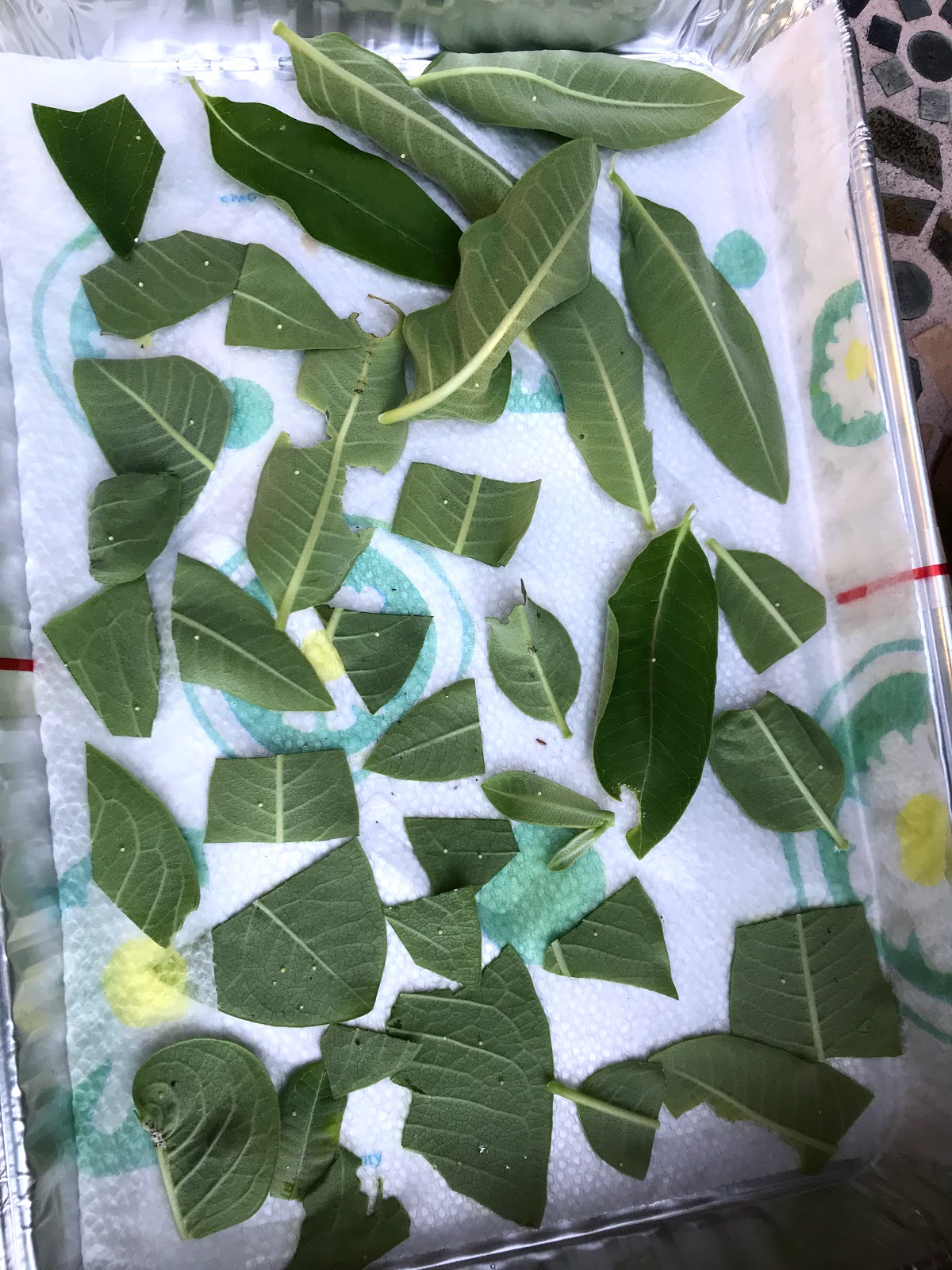

One more triumph....
There is a house in my neighborhood that has milkweed in their yard. ...a lot of milkweed! Last year at the end of July they cut it down, and I drove by one day and it was all in the trash! I almost stopped and knocked on their door, but didn't ..... fast forward to this year, I watched those milkweed begin to grow again. This time when they cut them down again in early June I stopped and pleaded with them to not cut them mid season. I saved 7 5th in star cats out of the destroyed pile of dead milkweed, 3 weeks later, end of June, they cut them again, so today (July 10) I stopped again, knocked on the door and asked if I could pull it for them, before they could weedwack it again. I saved 35 eggs, 3 large cats, and 16 babies!
So it's been a very busy week of triumphs and tragedy in my caterpillar kingdom. I may be in over my head with trying to SAVE all these caterpillars, but I'll do my best to give them a better shot at surviving then I believe they would have had otherwise. So as always I continue to SAVE the Monarch
Sunday, July 1, 2018
July 1. Update
We are only a month or so into the season and I have already raised and released nearly 50 butterflies! There was a few days that I didn't find anything as the first generation (in Minnesota) were busy mating and laying eggs, now I expect to find many more in the next two months as we head toward the Super Monarch generation that will migrate south to Mexico.
Last year I had only released 2 butterflies by now, and a total of 75. This year I'm expecting to triple that number!
A few people have asked me about tagging. Tagging begins mid to late August. Remember the current butterflies mate, lay eggs and die, so tagging them now does not serve any real purpose except to see if my released butterflies return to my own yard to lay eggs. Even then the odds of me seeing the female laying eggs in my garden is slim. So right now the significance of my releasing 50 plus healthy adults (almost 75% female) is that there are that many monarchs out there reproducing. So I continue to believe that those of us that are back yard scientists, just out there raising Monarchs in a safe environment are adding numbers to the population and making a difference to SAVE the Monarchs!! So keep up the good work. If this year is any indication the numbers are up and our efforts are helping.
#SavetheMonarch


Last year I had only released 2 butterflies by now, and a total of 75. This year I'm expecting to triple that number!
A few people have asked me about tagging. Tagging begins mid to late August. Remember the current butterflies mate, lay eggs and die, so tagging them now does not serve any real purpose except to see if my released butterflies return to my own yard to lay eggs. Even then the odds of me seeing the female laying eggs in my garden is slim. So right now the significance of my releasing 50 plus healthy adults (almost 75% female) is that there are that many monarchs out there reproducing. So I continue to believe that those of us that are back yard scientists, just out there raising Monarchs in a safe environment are adding numbers to the population and making a difference to SAVE the Monarchs!! So keep up the good work. If this year is any indication the numbers are up and our efforts are helping.
#SavetheMonarch


Saturday, June 16, 2018
Chrysalides a plenty!
Well this season is off to an amazing start. I will have butterflies hatching daily for the next several weeks. I'm hoping at least some of the females will return to lay eggs in my garden.
There seems to be a lull in the action temporarily until this new generation gets out and lays more eggs. I've joined two Facebook pages (Welcome to those who have found this blog through facebook) raising MONARCH butterflies, And Minnesota MONARCH crusaders. These fellow MONARCH lovers are doing great work for the cause, and it's a great resource to get questions answered by MONARCH lovers with a wealth of experience in the field. Amazing photos and videos posted.... check it out!
I'll post more next week as all these butterflies begin to eclose. My favorite time of the year! Until next time...,
Save the monarch!

There seems to be a lull in the action temporarily until this new generation gets out and lays more eggs. I've joined two Facebook pages (Welcome to those who have found this blog through facebook) raising MONARCH butterflies, And Minnesota MONARCH crusaders. These fellow MONARCH lovers are doing great work for the cause, and it's a great resource to get questions answered by MONARCH lovers with a wealth of experience in the field. Amazing photos and videos posted.... check it out!
I'll post more next week as all these butterflies begin to eclose. My favorite time of the year! Until next time...,
Save the monarch!

Saturday, June 9, 2018
June 8
The Monarch caterpillar season is going strong already! Every time I check plants for caterpillars I'm finding them. IT's been several years since that has happened, so what is different about this year? I'm not a scientist, but as with everything, it must have to do with climate. We can only speculate what it will mean for the Super Monarch population in August.
AS of the writing of this blog I have 1 Chrysalis, 1 in a J, 11 eggs and more caterpillars than I can count. Finding food, cleaning out frass and keeping track of babies and eggs takes many hours every day, but it's so much fun to watch the process and feel like my small caterpillar farm is making a difference.
AS always if you're experienced at this, or new to the idea, or thinking about joining the crusade, do some research before you get in over your head. It takes a lot of time and commitment and a bit of ingenuity to be a help for these beautiful butterflies. I am always willing to help, give advice, share ideas with newbies and there's lots of information online.
It's going to be a great summer!!
SAVE THE MONARCH!

Monday, May 28, 2018
Welcome to the 2018 Monarch season!
Welcome to the 2018 Monarch season!,
I have had several friends telling me that they have seen Monarchs around and I found several eggs in one of my favorite patches, as well as in my garden!
This is much earlier than in some years, so I am hopeful and encouraged what that means for the season and the population!
When I start to get excited about my caterpillars I often wake up with ideas on how best and easiest to raise them. Last year I created a habitat for my big cats out of an old aquarium, this year I created a habitat for my babies using a shoebox, florist tubes (available online or at bachmans) and a pop up cage that I purchased on Amazon I will include pictures below. The really nice thing about this is it is completely portable if I need to take babies with me if I'm out of town.
So go out and Save the Monarch!
The Monarch Lady


I have had several friends telling me that they have seen Monarchs around and I found several eggs in one of my favorite patches, as well as in my garden!
This is much earlier than in some years, so I am hopeful and encouraged what that means for the season and the population!
When I start to get excited about my caterpillars I often wake up with ideas on how best and easiest to raise them. Last year I created a habitat for my big cats out of an old aquarium, this year I created a habitat for my babies using a shoebox, florist tubes (available online or at bachmans) and a pop up cage that I purchased on Amazon I will include pictures below. The really nice thing about this is it is completely portable if I need to take babies with me if I'm out of town.
So go out and Save the Monarch!
The Monarch Lady


Wednesday, October 18, 2017
last blog of the season...
It was a good year for the Monarch. My final numbers were very encouraging. I raised 75 Monarchs. Of those I released 71, and tagged 39. I had 3 caterpillars die before reaching Chrysalis stage. So if you consider the odds of those nearly 80 caterpillars born/living in the wild only 2-3 would survive, I have done my best to help the population.
I had 2 butterflies "fall" at the very end of the season, and I've included the picture I took of those butterflies. I believe that the butterflies sometimes fall after eclosing (emerging) if the temperature is too cold for them to cling to the chrysalis. Last year I lost 4 of my last butterflies that hatched. This year I only lost 2, because I moved the Chrysalis so that if the butterfly fell it could climb back up to a hanging position before doing permanent damage to the wings. It has been shown that if the butterfly has something that it can crawl on such as mesh, or even paper towels that it will right itself. The butterflies in the below picture fell in a glass container, that they were unable to crawl on the glass, therefor the wings dry as shown in the picture, and the butterfly is never able to fly. That is also why it's imperative that when raising Monarchs that the butterfly is left to completely dry it's wings before it is disturbed.
If you are interested in trying to follow any of my tagged butterflies the website is
Monarchwatch.org and my tags are XUL200-XUL239 They usually begin reporting found butterflies around Feb. or March.
So until next season....Save the Monarch

I had 2 butterflies "fall" at the very end of the season, and I've included the picture I took of those butterflies. I believe that the butterflies sometimes fall after eclosing (emerging) if the temperature is too cold for them to cling to the chrysalis. Last year I lost 4 of my last butterflies that hatched. This year I only lost 2, because I moved the Chrysalis so that if the butterfly fell it could climb back up to a hanging position before doing permanent damage to the wings. It has been shown that if the butterfly has something that it can crawl on such as mesh, or even paper towels that it will right itself. The butterflies in the below picture fell in a glass container, that they were unable to crawl on the glass, therefor the wings dry as shown in the picture, and the butterfly is never able to fly. That is also why it's imperative that when raising Monarchs that the butterfly is left to completely dry it's wings before it is disturbed.
If you are interested in trying to follow any of my tagged butterflies the website is
Monarchwatch.org and my tags are XUL200-XUL239 They usually begin reporting found butterflies around Feb. or March.
So until next season....Save the Monarch

Friday, September 15, 2017
Tagging and Migration
So the question of the week is "How do you tag a Monarch?" Well, it's actually very easy, and apparently very effective. How many tags are placed on Monarchs each season, and how many are reported in Feb. and March? I have no way of knowing. There must be statistics that would answer that, but I'm not sure who would know. The tags I use are from Monarchwatch.org, which is an organization from Lawrence, Kansas I believe connected with Un. of Kansas. They are also my main information source about migration. According to this group the Leading edge of migrating Monarchs has reached Kansas and Missouri, so they are right on schedule for their journey to Mexico.
So back to the question "How do you tag a Monarch?" (see photos below) the tag is a very small sticker with a number on it. My tags are XUL201-XUL250. Each tag also has the Monarchwatch website listed on it, so if the butterfly is found in Mexico (or anywhere in between Minnesota and Mexico) the tag can be reported on the website with a location of findings. The tag is simply placed on the outside hind wing of the butterfly before release. So I will keep track of all my butterflies, male or female, and tag numbers. I should easily have tagged and released around 40 butterflies since Sept. 1, having raised about 75 this season.
So the final numbers are pretty impressive actually. I lost 3 caterpillars to the virus I mentioned in a previous blog, and I lost a few baby hatchlings just because they are extremely difficult to keep track of! So that puts my success rate at about 95%....those are much better odds than out in the wild. So again when people ask me "Why don't you just leave them outside?" The answer is a simple one. If a female Monarch lays 500 eggs, and only 10 or fewer of those eggs survive in the wild and I can give them a safer environment with a larger success rate than that, then I am helping the Monarch cause. I have also recruited friends and neighbors that are also helping the monarch, by helping me, or raising caterpillars and growing milkweed in their own yards. I figure that's about 100 Monarchs that might otherwise have perished without human help.
I just hope that the crazy weather that we are having doesn't have a negative effect on the population in Mexico, so that we have another good or better season next year. It will take several good seasons in order to revive the species so they are no longer in danger of extinction.
So for now I will continue my plight to SAVE THE MONARCH!! Carry on!
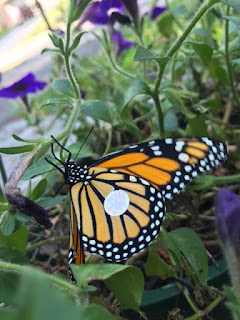

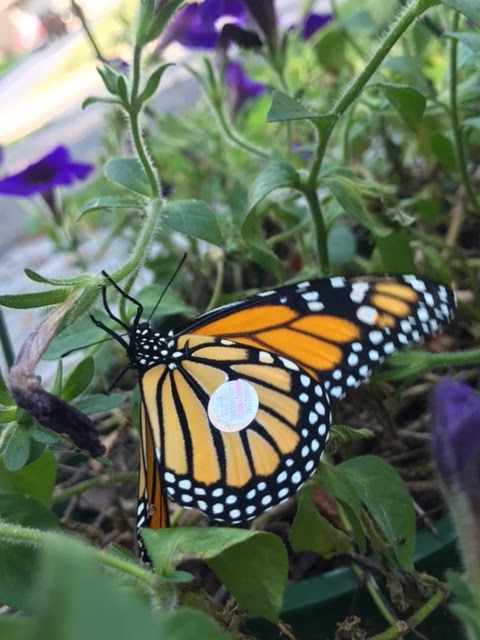
So back to the question "How do you tag a Monarch?" (see photos below) the tag is a very small sticker with a number on it. My tags are XUL201-XUL250. Each tag also has the Monarchwatch website listed on it, so if the butterfly is found in Mexico (or anywhere in between Minnesota and Mexico) the tag can be reported on the website with a location of findings. The tag is simply placed on the outside hind wing of the butterfly before release. So I will keep track of all my butterflies, male or female, and tag numbers. I should easily have tagged and released around 40 butterflies since Sept. 1, having raised about 75 this season.
So the final numbers are pretty impressive actually. I lost 3 caterpillars to the virus I mentioned in a previous blog, and I lost a few baby hatchlings just because they are extremely difficult to keep track of! So that puts my success rate at about 95%....those are much better odds than out in the wild. So again when people ask me "Why don't you just leave them outside?" The answer is a simple one. If a female Monarch lays 500 eggs, and only 10 or fewer of those eggs survive in the wild and I can give them a safer environment with a larger success rate than that, then I am helping the Monarch cause. I have also recruited friends and neighbors that are also helping the monarch, by helping me, or raising caterpillars and growing milkweed in their own yards. I figure that's about 100 Monarchs that might otherwise have perished without human help.
I just hope that the crazy weather that we are having doesn't have a negative effect on the population in Mexico, so that we have another good or better season next year. It will take several good seasons in order to revive the species so they are no longer in danger of extinction.
So for now I will continue my plight to SAVE THE MONARCH!! Carry on!

Saturday, August 26, 2017
Migration is beginning
Much of the information that I am going to post today comes from a website called "Journey North" that tracks the migration of Monarchs, hummingbirds, Whooping Cranes as they begin to Migrate for the season. It is from this information that I can say with confidence that the butterflies that are hatching from now on are the ones that will migrate to Mexico until spring. The numbers that survive their migration will have a direct correlation on the numbers that will return next year....assuming they remain safe and healthy upon arrival in Mexico.
Monarchs that emerge from Chrysalis at this time of year are unique. i.e. "Super Monarchs" their focus is on nectaring, and storing up fat for their long journey. They emerge in a state called Diapause, which means they are fully developed, but not mature reproductively. The same hormone that causes the state of diapause, also enables the Monarch to survive for 8 Months, instead of 2-6 weeks. It's believed that changes in temperature, and light signal this change in the late season hatchlings. I have noticed that we have had an unusually cool and wet August here in Minnesota, and the egg laying and caterpillar numbers have rapidly declined. I am also noticing that the butterflies stay in a Chrysalis state longer in August than June and July.
I am excited that year to date I have released 35 butterflies, and am looking for about that many more to send to Mexico! I have ordered tags from MonarchWatch.org so I can tag my butterflies that I will be releasing in the coming month. These tiny tags get reported on a website printed on the tag if the butterfly is found in Mexico. I do not expect the butterflies to return in the spring. This is a piece of the migration that seems to confuse most people. I say again, the butterflies that I release this Month, and next will fly to Mexico. If they survive the journey down, they will overwinter in huge trees in the mountains of Mexico then in early March they begin to journey back north. Those butterflies only make it about as far as Texas then they lay their eggs and die. So they butterflies that return to the north next season are the great great grandchildren of those that migrate this fall. It boggles my mind that these tiny creatures have the ability to do that. Flying 50 or more miles everyday, and arriving in southern Mexico around Halloween.
So to you that follow this blog, and have taken the leap and begun to raise your own butterflies this season the Monarchs are better off because of you. If you release 5 butterflies, chances are those are at least 4 more than would have survived in the wild, and if enough of us do that it has to make a difference!! Keep up the good work. Save the MONARCH!
Monarchs that emerge from Chrysalis at this time of year are unique. i.e. "Super Monarchs" their focus is on nectaring, and storing up fat for their long journey. They emerge in a state called Diapause, which means they are fully developed, but not mature reproductively. The same hormone that causes the state of diapause, also enables the Monarch to survive for 8 Months, instead of 2-6 weeks. It's believed that changes in temperature, and light signal this change in the late season hatchlings. I have noticed that we have had an unusually cool and wet August here in Minnesota, and the egg laying and caterpillar numbers have rapidly declined. I am also noticing that the butterflies stay in a Chrysalis state longer in August than June and July.
I am excited that year to date I have released 35 butterflies, and am looking for about that many more to send to Mexico! I have ordered tags from MonarchWatch.org so I can tag my butterflies that I will be releasing in the coming month. These tiny tags get reported on a website printed on the tag if the butterfly is found in Mexico. I do not expect the butterflies to return in the spring. This is a piece of the migration that seems to confuse most people. I say again, the butterflies that I release this Month, and next will fly to Mexico. If they survive the journey down, they will overwinter in huge trees in the mountains of Mexico then in early March they begin to journey back north. Those butterflies only make it about as far as Texas then they lay their eggs and die. So they butterflies that return to the north next season are the great great grandchildren of those that migrate this fall. It boggles my mind that these tiny creatures have the ability to do that. Flying 50 or more miles everyday, and arriving in southern Mexico around Halloween.
So to you that follow this blog, and have taken the leap and begun to raise your own butterflies this season the Monarchs are better off because of you. If you release 5 butterflies, chances are those are at least 4 more than would have survived in the wild, and if enough of us do that it has to make a difference!! Keep up the good work. Save the MONARCH!
Saturday, August 19, 2017
Final butterflies of the season
I have not had any more caterpillars succumb to parasites, or viruses. As of today I have released 23 healthy Monarchs, I have 4 that will hatch today, still another 6 or more in the next week, and too many caterpillars to even count, so I am far from finished with the season. It's exciting to think that all will be heading to Mexico that will be released in the next few weeks, so it's doubly important that they are healthy and strong! I have noticed a decrease in eggs and caterpillars out in the wild, and I'm wondering if that has to do with cooler and wetter than average August. I am curious if they will rebound if it warms up, as it is predicted to do. I will continue to look for another couple weeks, but I am cautious about raising any that will hatch too late to fly south, as last year all my late hatchlings died, which was very traumatic for me. I believe it was simply due to it being too cold for them to survive.
I took some fun pictures over the past week....the first is a picture of a milkweed plant in my aquarium with a caterpillar on almost every leaf, all different instars (sizes), then in comparison the same plant after those caterpillars had done their work! The other one is a photo of my daughter helping to release a female, and it's sitting on her shoulder.
As always....keep raising those butterflies. I believe we are making a difference!
Spread the word and Save the MONARCH!
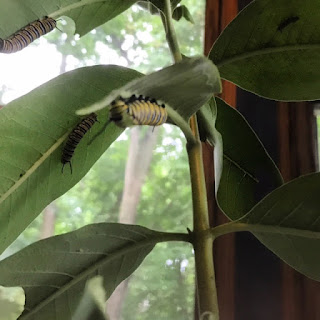
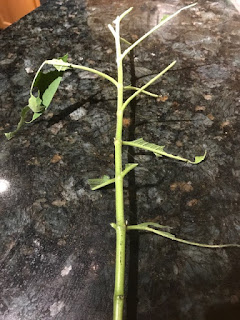

I took some fun pictures over the past week....the first is a picture of a milkweed plant in my aquarium with a caterpillar on almost every leaf, all different instars (sizes), then in comparison the same plant after those caterpillars had done their work! The other one is a photo of my daughter helping to release a female, and it's sitting on her shoulder.
As always....keep raising those butterflies. I believe we are making a difference!
Spread the word and Save the MONARCH!


Friday, August 11, 2017
NPvirus
Its been an interesting week! I have had beautiful healthy butterflies hatch every day this week. The highlight was 4 females all on Wednesday! Eggs, and caterpillars remain abundant this year.
That's all good news!! Bad news this week, I learned about, and experienced first hand what I believe is called NPvirus...NPV. I noticed one of my largest cats this AM dangling lifelessly from a chewed leaf, with a green substance on the paper towels beneath it. So I visited the expert that I have mentioned many times (Rich Lund) mrlundscience sure enough he had experienced a similar episode, and his information was informative, and discouraging!! I removed all my caterpillars from big enclosure, and it will need to be sterilized with a bleach solution. I am hoping I will not have to euthanize any more of my large cats! I will monitor them closely until they do their thing! The good news is that most of my caterpillars are already in Chrysalides, so I think they are safe! I hope they are safe!! There were only 4 or 5 big ones that were potentially exposed to the virus. I have about 15-20 that are still too small to release into the big enclosure, so I think they are all safe, as long as I don't have another outbreak! yuk
So that's the news from the caterpillar world. If you are following this blog, and are raising your own caterpillars/Monarchs please visit mrlundscience You-tube videos to learn more about these threats to our Monarchs!! The last generation of the season is here. They are the super Monarchs that will go to Mexico. The more healthy butterflies that we release, the more hope there will be for next year's season to be a repeat of this year!! We need several years in a row like this year in order to revive the species!! Keep up the good work.
Save the MONARCH!
That's all good news!! Bad news this week, I learned about, and experienced first hand what I believe is called NPvirus...NPV. I noticed one of my largest cats this AM dangling lifelessly from a chewed leaf, with a green substance on the paper towels beneath it. So I visited the expert that I have mentioned many times (Rich Lund) mrlundscience sure enough he had experienced a similar episode, and his information was informative, and discouraging!! I removed all my caterpillars from big enclosure, and it will need to be sterilized with a bleach solution. I am hoping I will not have to euthanize any more of my large cats! I will monitor them closely until they do their thing! The good news is that most of my caterpillars are already in Chrysalides, so I think they are safe! I hope they are safe!! There were only 4 or 5 big ones that were potentially exposed to the virus. I have about 15-20 that are still too small to release into the big enclosure, so I think they are all safe, as long as I don't have another outbreak! yuk
So that's the news from the caterpillar world. If you are following this blog, and are raising your own caterpillars/Monarchs please visit mrlundscience You-tube videos to learn more about these threats to our Monarchs!! The last generation of the season is here. They are the super Monarchs that will go to Mexico. The more healthy butterflies that we release, the more hope there will be for next year's season to be a repeat of this year!! We need several years in a row like this year in order to revive the species!! Keep up the good work.
Save the MONARCH!
Sunday, August 6, 2017
August 6, eggs, babies and Chrysalides
There will be a butterfly explosion at my house this week. All those Chrysalides that formed last weekend should hatch this week....very exciting! A friend and I went "hunting" last Friday, and found at least 20 more eggs, and three baby cats. I am still not seeing large (4th instar) cats out in the wild, so I continue to believe the safest place for them is in my care. I am seeing so many more butterflies this year, which just makes me happy.
I watched some of the "mrlundscience" videos on youtube this week and he is feeling the same optimism about this years season, however, he also cautions that one good season is not enough to save this species and we must remain vigilant and continue to spread the word about planting milkweed, and encouraging our city governments to not mow it down! (especially in July and August!)
I also watched a video about the OE Virus that attacks Monarchs and spreads on milkweed. It seems it's not a huge problem here in the midwest, but I have had caterpillars, and butterflies die that must have been infected. More often than killing the caterpillar or butterfly it lives on the adult Monarch, then is spread when it lands on milkweed to feed or lay eggs. Very fascinating! If you're interested in more detail, please watch the videos produced by Mr. Lund.
Below are pictures of eggs, and a few of my chrysalides. I hope I can get pictures, maybe even video of all this butterflies emerging this week! In the meantime, Thanks for caring....SAVE the MONARCH!!


I watched some of the "mrlundscience" videos on youtube this week and he is feeling the same optimism about this years season, however, he also cautions that one good season is not enough to save this species and we must remain vigilant and continue to spread the word about planting milkweed, and encouraging our city governments to not mow it down! (especially in July and August!)
I also watched a video about the OE Virus that attacks Monarchs and spreads on milkweed. It seems it's not a huge problem here in the midwest, but I have had caterpillars, and butterflies die that must have been infected. More often than killing the caterpillar or butterfly it lives on the adult Monarch, then is spread when it lands on milkweed to feed or lay eggs. Very fascinating! If you're interested in more detail, please watch the videos produced by Mr. Lund.
Below are pictures of eggs, and a few of my chrysalides. I hope I can get pictures, maybe even video of all this butterflies emerging this week! In the meantime, Thanks for caring....SAVE the MONARCH!!


Sunday, July 30, 2017
July 30
Very interesting, and exciting weekend. All the caterpillars that we found a couple weeks ago all spun within about 24 hours on Fri and Sat. It was amazing to witness. I actually saw 2 Chrysalides form from start to finish. My daughter managed to film at least part of one of them spinning. I also had 4 more eggs hatch, and I managed to take a picture of 2 baby Cats, approximately 1 and 3 days old. The photo (zoomed in) shows how fast these little critters grow, and also how unbelievably small they are when they begin their lives.
So, again I am very encouraged that I am seeing so many caterpillars, monarchs and milkweeds, and finding more and more people that are finding the joy in raising these beautiful creatures, hoping to ensure their survival. I am happy to pass my experiences, and advice on to anyone who will listen. I can't wait for all these chrysalides to hatch now. That will be another eventful 24 hours!
Save the Monarchs!


So, again I am very encouraged that I am seeing so many caterpillars, monarchs and milkweeds, and finding more and more people that are finding the joy in raising these beautiful creatures, hoping to ensure their survival. I am happy to pass my experiences, and advice on to anyone who will listen. I can't wait for all these chrysalides to hatch now. That will be another eventful 24 hours!
Save the Monarchs!


Wednesday, July 26, 2017
July 26
Well it is the end of July, and the Monarch and Caterpillar season are in full swing. I am very excited about the numbers of caterpillars and butterflies that I am seeing, and about the numbers of milkweed that I see when I'm driving around. I really feel like people are getting the message, and are proactively doing their part to save our pollinators! Everywhere I go people ask for my expertise and advice about raising caterpillars, and obviously I love talking about it! These amazing creatures just never cease to amaze me. I love to watch them! This week I witnessed 2 cats on the same leaf fighting. I didn't watch long enough to see how it was resolved, but I'm sure eventually one of them just gave in and moved to another leaf, but it was sort of funny to me.
Well, as promised I took some pictures of my enclosure that I built this past weekend...pictures below. Let me tell you what I did, cause it's hard to tell from the photos. It's a large aquarium turned on end, so it's about 2 Ft. tall, then I covered the opening with removable netting, which I Velcroed to the frame. One of the short sides was missing the glass anyway, so I covered it with a sturdy piece of cardboard, weighted down with books, so when it has chrysalides on it I can easily remove them with out disturbing the caterpillars below as needed. The removable netting also makes it easy to access the caterpillars without disturbing chrysalides. Just in time I was able to move in 12 large Cats, 12 tiny Cats, and 5 eggs. I still am keeping the eggs and tiny newly hatched cats away from the largest ones in a separate container.
So this season has started much stronger than last few years. I have also released 4 butterflies, 2 male, and 2 female.
That's all for now.....Save the MONARCH! I welcome your questions and comments.


Well, as promised I took some pictures of my enclosure that I built this past weekend...pictures below. Let me tell you what I did, cause it's hard to tell from the photos. It's a large aquarium turned on end, so it's about 2 Ft. tall, then I covered the opening with removable netting, which I Velcroed to the frame. One of the short sides was missing the glass anyway, so I covered it with a sturdy piece of cardboard, weighted down with books, so when it has chrysalides on it I can easily remove them with out disturbing the caterpillars below as needed. The removable netting also makes it easy to access the caterpillars without disturbing chrysalides. Just in time I was able to move in 12 large Cats, 12 tiny Cats, and 5 eggs. I still am keeping the eggs and tiny newly hatched cats away from the largest ones in a separate container.
So this season has started much stronger than last few years. I have also released 4 butterflies, 2 male, and 2 female.
That's all for now.....Save the MONARCH! I welcome your questions and comments.


Friday, July 21, 2017
July 21
So far, this season seems like an improvement over last year. I have had much better luck finding eggs and tiny caterpillars this year. My daughter, a friend, and I went hunting last night and brought home many of the eggs and babies I currently possess. I currently have 2 chrysalides, 3 large caterpillars, nearly 20 babies, and 8 eggs. That is far ahead of last years numbers. I am also seeing Monarchs in my garden, and frequently out on walks and while driving around. I'm still not seeing large 3rd or 4th Instar caterpillars, but it's still early. Some of the ones that I have taken into captivity would have (hopefully) survived if left out in the wild. I have plans this weekend to create a large habitat out of an old aquarium, so I will let you know next week how that goes and post pictures. As all these babies grow, they need LOTS of space and milkweed. Please don't try to save the Monarch population, unless you are prepared to provide the space, and the food for them to grow. I believe there are more and more people out there that care and are aware that we need to do everything we can to save this species. How sad would it be if my grandchildren never get to see a Monarch butterfly?!! So keep up the good work, and as always, I welcome your questions, comments and ideas. Together, we can Save the Monarchs!
Friday, July 14, 2017
Monarch season underway July 14
My first post of the season! I have been busy searching for baby caterpillars, and eggs, but the season has started slowly. I have connected to a new friend, and fellow butterfly enthusiast (Cheryl Natt) that to my delight lives very near me, so I hope we can perhaps connect with others in our area as well. Perhaps a Monarchlady club?! She was lucky enough to have had better luck finding eggs, and had quite a few cats of all different instars and roughly a dozen chrysalides, that she shared with me. I also found 1 egg, and 2 babies in my yard today, so I am more hopeful than I was a week ago. I believe I only found 3 cats in my garden all of last year, so that is good news that I've found that many already this year, and it's only mid July! I also saw an article this week that indicated that the DNR has ask for 70 million dollars to plant milkweed along I-35 from Minnesota to Texas!
Please let me know what you are finding in your gardens! Save our pollinators!
This photo is of my surprise hatchling this Wednesday....didn't notice it was ready to hatch on tuesday, and it was waiting for me at Breakfast.

Please let me know what you are finding in your gardens! Save our pollinators!
This photo is of my surprise hatchling this Wednesday....didn't notice it was ready to hatch on tuesday, and it was waiting for me at Breakfast.

Tuesday, September 13, 2016
Super Monarchs
The days are getting shorter, the nights are getting cooler, and it's time for our Monarch friends to fly south to avoid the cold and snow. I again was part of the Minnesota Monarch Festival held last Saturday Sept 10th at Lake Nokomis. I enjoy teaching, and just sharing my love and knowledge about Monarchs with anyone who will listen, so as you can imagine this festival is one of the highlights of my summer. We tagged and released over 200 Monarchs to send to Mexico. If you happen to find, or see a tagged Monarch, the tags are a tiny white circle on the hind wing, report your finding if possible.
I have lost track of exactly how many butterflies I have actually released that I raised this summer, but I'm figuring by the time September ends (I still have 4 caterpillars, and 7 chrysalises) I will have released nearly 40 butterflies. I have also shared them with friends, and neighbors so they can enjoy this beautiful process. While that is a small drop in the bucket, the lack of caterpillars this summer is a huge concern. I feel like I should have had more than twice that number if numbers of butterflies were more normal. If you are reading this and are in the Minneapolis area and would like to help me in this mission I have Milkweed seeds in a MilkCrate at the end of my driveway, please plant Milkweed and butterfly friendly flowers in your garden ( they need SUN) and you too will have butterflies and caterpillars in your garden. Help me Save the Monarch!
Here is my pretty girl hatched today, and my handsome male! See if you can identify the difference.
Hint (Male has a black dot on the hind wings....Female does not) Also if you notice the veins in the male are thinner than the female. These two butterflies are headed to Mexico....safe travels.


I have lost track of exactly how many butterflies I have actually released that I raised this summer, but I'm figuring by the time September ends (I still have 4 caterpillars, and 7 chrysalises) I will have released nearly 40 butterflies. I have also shared them with friends, and neighbors so they can enjoy this beautiful process. While that is a small drop in the bucket, the lack of caterpillars this summer is a huge concern. I feel like I should have had more than twice that number if numbers of butterflies were more normal. If you are reading this and are in the Minneapolis area and would like to help me in this mission I have Milkweed seeds in a MilkCrate at the end of my driveway, please plant Milkweed and butterfly friendly flowers in your garden ( they need SUN) and you too will have butterflies and caterpillars in your garden. Help me Save the Monarch!
Here is my pretty girl hatched today, and my handsome male! See if you can identify the difference.
Hint (Male has a black dot on the hind wings....Female does not) Also if you notice the veins in the male are thinner than the female. These two butterflies are headed to Mexico....safe travels.


Thursday, September 1, 2016
September 1, 2016 Blog Update
September 1, Wow this summer has gone fast. I hope you've enjoyed this blog, and perhaps have learned something about this beautiful creature we call a Monarch butterfly and how/why it's important that we save it! I am very encouraged at the effort that I see in my own community to create habitat, gardens and allow milkweeds to grow where a few years ago they would have been pulled, mowed, or sprayed! I want to include some resources on this blog for you to continue to follow Monarchs, and all of our migrating birds and butterflies. Check out Journey North Website
http://learner.org/jnorth/
Journey North engages citizen scientists in a global study of wildlife migration
it's a great website for all things Monarch and beyond. Another great site is
Monarchwatch.org it has gifts, resources, plants and information about raising Caterpillars. Last but not least, if you live in the Minneapolis Metro Area please put the Monarch Festival on your calendar of summer activities Saturday September 10th, 10 AM - 4PM Lake Nokomis Park, Minneapolis Mn. Monarchfestival.org It's great festival for kids and parents. Education tents, face painting, mexican style food, and people dressed up as butterflies!
Finally to report on my end of the season caterpillars. I hatched a dozen eggs last week. I gave away 5 caterpillars to neighbors to help me raise. I currently have 3 chrysalises, 1 3rd instar, and 9 2nd instar babies. When they are all big enough to take a photo of I will post. You can't imagine how small these caterpillars are when they first hatch. They are very difficult to keep track of! They are all big enough now that I can see them, but not really big enough to show up in a photo, but all of them will eventually fly to Mexico!
http://learner.org/jnorth/
Journey North engages citizen scientists in a global study of wildlife migration
it's a great website for all things Monarch and beyond. Another great site is
Monarchwatch.org it has gifts, resources, plants and information about raising Caterpillars. Last but not least, if you live in the Minneapolis Metro Area please put the Monarch Festival on your calendar of summer activities Saturday September 10th, 10 AM - 4PM Lake Nokomis Park, Minneapolis Mn. Monarchfestival.org It's great festival for kids and parents. Education tents, face painting, mexican style food, and people dressed up as butterflies!
Finally to report on my end of the season caterpillars. I hatched a dozen eggs last week. I gave away 5 caterpillars to neighbors to help me raise. I currently have 3 chrysalises, 1 3rd instar, and 9 2nd instar babies. When they are all big enough to take a photo of I will post. You can't imagine how small these caterpillars are when they first hatch. They are very difficult to keep track of! They are all big enough now that I can see them, but not really big enough to show up in a photo, but all of them will eventually fly to Mexico!
Subscribe to:
Posts (Atom)